Friday, September 10, 2010

Assessment & School as Dramatic Theater


Understanding & Misconceptions


Again this year, the 6th grade science curriculum opens with a unit entitled The Nature of Understanding & Misconceptions, organized around the following understanding goals:

What is understanding?
How do we know when we understand something?
How do we acquire understanding?
Why should we teach for understanding?
(What is the consequence of not teaching for understanding?)

What is a misconception?
Where do misconceptions come from?
How do we find and challenge misconceptions?

Students are introduced to the distinction between knowing about something versus understanding through a series of activities and discussions, including the battery and bulb problem (can you light a bulb using only a battery and one wire?), and the explanation of why there are seasons on the planet Earth. (See What is Understanding for a more detailed description of this unit.)

Despite having studied electricity in earlier grade levels, few students were able to light the bulb. Some recalled hearing the word circuit, but none were able to apply the concept with any degree of understanding or flexibility. Nearly all self-assuredly predicted that they could do it.

The result was the same when it came to explaining the cause of the seasons. Explanations included the following:

the seasons are caused by clouds blocking the sun
in the winter a planet comes between the Earth and the Sun, thus blocking its rays
in the winter we face way from the sun
in the winter the Earth is further from the sun

A few students recalled that the Earth is tilted on its axis, and knew that the tilt was somehow connected with the seasons, but none knew about direct and indirect sunlight.

Note the following clips of the kids' discussions and group presentations.


Dina Matt Wala Don Matt Boul Diokhe Sa Lokho: If You're Not Sure Whether It Bites, Don't Offer It Your Hand: Conversations With Abdul


I wish to acknowledge here that Abdoul and I have begun meeting again, and we are continuing to read the Holy Qur'an from back to front, the shorter suras first. At the time of this writing, we've reached sura 72.

Our conversations continue to center on a more psychological interpretation of the Qur'an, and our recent discussions have included topics such as the connection between a sura and its historical context, the meaning of effort and good works, the meaning of Paradise/Hell, Paradise as represented on a continuum, like a range of hotels with various qualities of rooms, the meaning of zikr, ego-grasping from a Muslim perspective, Djola initiation and jinn (from a Muslim perspective), the meaning of animism, etc.

All fascinating.

Sunday, September 5, 2010

A Saturday in Senegal: Carving, Washing, Filleting

1
2
3
4
5
6
7
8
9
10
11
12
13
14
15
16
17
18

This being my final year teaching and living in Senegal, I'm mindful of things that I must accomplish, places to visit, and souvenirs to acquire.

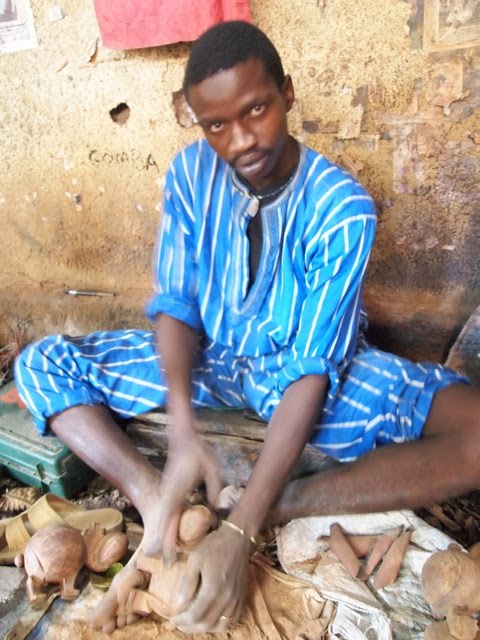
Yesterday, Almamy, Marje (a pre-K teacher at ISD, my swim partner, and downstairs neighbor) and I walked around the artisans' market at Soumbedioune, with the intent of visiting a wood carving cooperative. There men worked assembly line-style, transforming raw wood into finished carvings. We had visited the workshop several times in the past two years, and I had wanted to focus on taking photos, and collect samples of work in progress. (Note photos 1-6, and the four little monkey carvings at the top of photo9.)

We visited the shop of the man in photo7, who was carving masks in intricate detail. His kit of handmade tools was beautiful. He had even forged the adze blades, of varying width. With Almamy's help, I purchased four of the tools, shown in photo8, along with two wooden mallets used in the cooperative workshop. (You can see them being used in photos 4-6.) The owner was quite amused by my interest in his tools, and appreciative that they would be shared with my young students.

We also visited with a group processing hides, of all kinds, from crocodile, snake, sheep and goat. See photos 11-13. The hides are soaked with the fruit of a particular tree, then rinsed and stretched.

In the afternoon, Marje and I accompanied a small group of ISMers to the Yoff fish market. See photos 14-18. Description of photos 14-18: photos 14-15: it is not uncommon to find billfish here, caught on hand lines, Hemingway come alive; photo16: Yoshiko has a small sushi business, and is on the left negotiating for the purchase of fresh fish; photo17: parrotfish, a fish common in the Caribbean, are eaten here in Senegal; photo18: a group of kid snorkelers pose with their day's catch.

Christening


Senegalese love to grill things, particularly fish, and they do so on a barbeque that is commonly sold in markets. Wood charcoal from the Casamance serves as fuel. It's a clever design, similar in principle to a charcoal chimney starter, though I followed Lena's advice and heated a handful of briquettes on the gas stove.

Marje, Almamy and I toured the Kermel Market yesterday, with the aim of purchasing seafood: two pink lobster and several large foot-long shrimp. The meal was a kind of christening -- for the barbeque, the new school year, and my wish to do a little more entertaining this year.

Sam and Stephanie came for dinner, two Floridians, on a evening that was pleasantly breezy, cool and relatively dry.

Stephanie is the daughter of a retired NASA engineer and was raised in the shadow of the Kennedy Space Center on Satellite Beach, Florida, at a time when the state was relatively unspoiled. The three of us are of a similar generation and experience: White Castle burgers, Jekyll Island, manatees, Florida summer thunderstorms, and diving in warm, clear water.

And thus a new school year begins.

Saturday, September 4, 2010

Lucie In The Sky With Scissors


In the first two weeks of the school year, Lucie presented herself as sweet, reserved and meticulous. Her mask decoration was uniquely original, painted with an eye for detail. I wondered whether she had family members who were artists, as is often the case with children who demonstrate a propensity and facility for rendering. Yes, she confided, her grandmother had illustrated a book. I think Lucie's inherited the genes.

Another side of Lucie revealed herself on Friday during the Elephant Ring activity. Students were challenged to create, from a single sheet of paper, a unbroken ring large enough that an elephant could walk through; or that the classroom could pass through; or the planet. Was it possible?

For the young physicists in the room, this thinking/construction exercise can lead in interesting, mind-stretching directions. What is the thickness of the largest possible unbroken ring? Can we imagine a ring the width of a molecule? How large would that ring be? How do we calculate it?

Lucie, and her partner Marietou, struck on a solution early on, and Lucie was ecstatic. I got it, I got it, I got it! This otherwise shy young lady bounced, and flapped, and giggled, and twirled, like a penguin on caffeine. Marietou, I asked, you must help your partner, she's going nutz!

We inhabit many sides, many moods, conditioned, drawn to center stage by the milieu. Over the course of the school year, we have the opportunity to observe this in our students, and they have the opportunity to observe the many sides of Mr. Spedding.

In this way, teaching is a kind of psychotherapy. I spend my days with a classroom of analysts who, at this grade level, are generous with their assessments.

Mask Decoration 8.30/31

1
2
3
4
5
6
7
8
9
10
11
12
13
14

For context, see masking-making.