Friday, February 4, 2011

Book Month Kickoff 2.1

1
2
3
4
5
6
7
8
9
10
11
12
13
14
15
16
17

Book Month is a school-wide reading competition between four teams, designed by color -- red, blue, green and yellow. The kick-off had all 400+ ISD students in the gym cheering for their team colors, guided by librarian Roxanne Segal.


I am, sadly, a slow, plodding reader: I tend to chew each paragraph, not unlike how I eat chicken wings. Are there points for chewing?

Fortunately, my teammates include a few heavy-weight readers, such as Stephanie and Mahima, who inhale books and series and authors, so there is hope.

Go yellow!

Distinguishing Sands 2.2

1
2
3
4
5
6
7
8
9
10
11
12
13
14
15
16
17

Photos (top to bottom): photo1: Tori, Ali & Kenny; photo2: Franklin & Brittany; photo3: Alice & Ben; photo5: the kids spread out on the ISD central field, taking advantage of the light and space; photo6: Mourtada; photos 7&8: Jasmine, Anais & Kosuke; photo9: Emilie records her data; photo10 & 11: Abel, Ethan & Tom; photo12: Franklin, Brittany, Sheila & Mansur; photo13: Tori & Kenny; photo14: Ben gets in a final glimpse; photo15: Aleah & Lucie; photo16: Margret, Bella & Bobby; photo17: Lucie.


We are currently edging toward the end of a unit on geology and the natural history of the Cap Vert Peninsula, where Dakar is located. Students are here studying the composition of sand, and carefully observing its physical features so as to determine it's source -- a beach, a desert, a mountain stream, or some other locale.

The world of the very small -- whether the microscopic or or atomic -- is relatively new for the 6ers and so generates a lot of interest/curiosity. Having access to cool toys like dissecting microscopes makes it all the more fun.

Geology Field Trip 2: Cap Manuel 2.3/4

1
2
3
4
5
6
7
8
9
10
11
12
13
14
15
16
17

The 6th grade science curriculum here focuses on earth science, followed by life and physical science in the next two years.

There is no better spot in the county to observe and explore geology and natural history than right here, on the Cap Vert Peninsula. The geological story includes the opening of the Atlantic following the break-up of Pangea, and two relatively recent but distinct volcanic events: the earlier during the Tertiary Period, about 8 mya, when the area around downtown Dakar was formed, along with Ile de Madeleine and Ile de Goree; and the more recent, about 1 mya, with the explosive eruption of the now extinct Mamelles volcanoes.

Cool, eh?!

Note to self: Produce a Bill Nye-esque video program with the kids featuring the natural history of the peninsula, filmed on location.

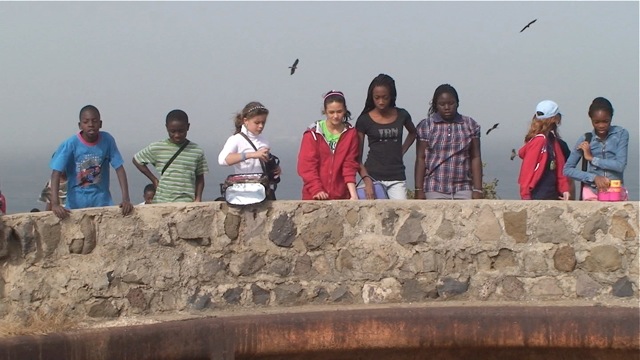
The field trip to Cap Manuel is extraordinary, with basalt columns (we found an area where we could walk across the upper surface of the columns), and access to the basement limestone. It is also the site of very interesting and overlapping histories: a large assemblage of stone tools were excavated here (now housed at the University of Dakar); and the remnants of WWII era French gun emplacements are numerous, the specific history of which I've begun exploring. Squatters now reside in the gun emplacements. What a view!

Note videos: